
The 4 Main Categories of Cleaning Agents: What They Are and When to Use Them
 You grabbed a cleaner, used it the way the label said, and the surface still looks off — or worse, it looks damaged. Sound familiar? Understanding the 4 main categories of cleaning agents isn’t chemistry homework. It’s the reason some jobs come out right and others don’t. Detergents, degreasers, abrasives, and acids or alkalis each do something specific — and when you match the wrong one to the wrong surface, you don’t just lose time. You can ruin what you were trying to clean. We work across Orlando properties constantly, and the pattern is always the same: the people who get the best results aren’t using better products. They’re using the right category for the job. Here’s exactly how each one works, when to reach for it, and when to leave it on the shelf.
This isn’t about memorizing chemistry. It’s about knowing which tool fits which problem. Here’s how each one works.
Category 1: Detergents
Detergents are the most common cleaning agents you’ll run into. They work by lowering the surface tension of water, letting it spread out and lift dirt away from surfaces. The active ingredients — called surfactants — attach to both water and grease at the same time, which is why soap can rinse away oily residue that plain water can’t touch.
Detergents are your everyday workhorses. Think dish soap, laundry detergent, most all-purpose sprays. They’re pH-neutral or close to it, which makes them gentle on most surfaces. Countertops, floors, glass, most fabrics — you can use them without worrying about damage.
Here’s what most guides get wrong: detergents stop working well when they’re diluted too much or used in hard water. Hard water contains calcium and magnesium minerals that bind to surfactants and reduce their effectiveness. In Central Florida, where water hardness levels can run high depending on your source, this actually matters. A detergent that works great in one building may leave a film in another.
Use detergents when the soil is light to moderate, the surface is general-purpose, and you need something safe for repeated contact. They’re not the right call for heavy grease buildup or mineral deposits. That’s where the next category comes in.
Category 2: Degreasers
Degreasers are built for one thing — cutting through oil, grease, and fat. Typically alkaline (high pH), they chemically break down fatty acids and lipids instead of just lifting them away. That’s why they’re the go-to for commercial kitchens, garages, and any surface that sees heavy cooking or mechanical work.
The chemistry here is called saponification. When a strong alkaline cleaner hits animal fat or cooking grease, it converts it into a water-soluble soap that rinses away cleanly. That’s a real chemical reaction — not just “cutting” grease in a marketing sense.
Where people go wrong is using degreasers on surfaces that can’t handle high pH. Aluminum can corrode when exposed to strong alkalis. Natural stone like marble or travertine — which we see a lot of in higher-end properties around the Suite G-100 Orlando area — will dull and etch if you hit it with an alkaline degreaser. Always check your surface before you choose your agent.
Use degreasers when you’re dealing with cooking grease, motor oil, wax buildup, or any heavy lipid-based soil. Ventilation matters — many degreasers release fumes that build up fast in enclosed spaces, and research on cleaning agents’ health hazards confirms that repeated exposure in poorly ventilated areas carries real occupational risk. If you’re regularly dealing with grease-heavy environments and aren’t sure which formulation is safe for your surfaces, it might be worth talking to a janitorial maintenance team in Orlando about the right product match before damage occurs.
Category 3: Abrasives
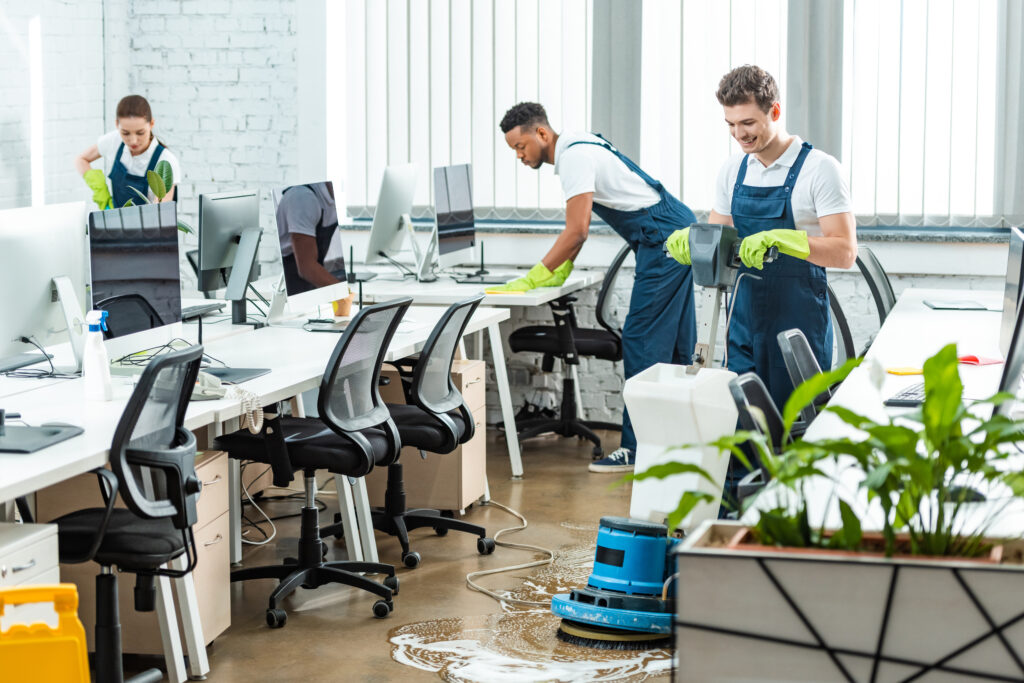 Abrasives work mechanically, not chemically. Friction is the whole point — physically scrubbing away soil, stains, or surface layers. You’ll find them in powdered cleaners, scrubbing pads, pumice sticks, and some paste-style products.
This category gets less attention than it deserves. Honestly, abrasives are often the right answer when chemical cleaners have already failed. Baked-on food, hard water scale on porcelain, rust stains on concrete — sometimes you just need mechanical action.
The risk is obvious: abrasives scratch. A coarser abrasive means a more aggressive scratch pattern. On stainless steel, the wrong abrasive pad leaves visible scratches that trap bacteria and look terrible. On glass, anything too coarse can cause permanent hazing. Here’s the nuance most people miss: abrasive level matters more than the product name. A “soft scrub” product might have a very fine abrasive that’s safe on most surfaces, while a heavy-duty scouring powder can be aggressive enough to damage coated surfaces. Always test in an inconspicuous spot first. We do this on every job, no exceptions.
Use abrasives when chemical cleaners haven’t worked, the surface is hard and durable (like unglazed ceramic or raw concrete), and you need to physically remove a layer of soil or staining. Avoid them on soft metals, coated surfaces, and anything glossy you want to stay that way.
Category 4: Acids and Alkalis
This is where things get serious. Acids and strong alkalis are the most powerful cleaning agents — and the most likely to cause damage or injury if misused. They work by chemically reacting with specific types of soil or buildup, breaking them down at the molecular level.
Acids (low pH) dissolve mineral deposits, rust, and lime scale. Seen white crusty buildup around a faucet or inside a toilet bowl? That’s calcium carbonate — and acid dissolves it fast. Toilet bowl cleaners, rust removers, and tile grout cleaners often use acidic formulas.
Strong alkalis (very high pH) handle protein-based soils — blood, food residue, and some types of mold. Drain cleaners and oven cleaners use them too. The reaction is fast and effective, but it doesn’t discriminate. A strong alkali will damage skin just as readily as it breaks down grease.
And this is the thing that gets people hurt. Mixing acids and alkalis together — even when both products are labeled “cleaning products” — can create dangerous gases. Bleach (an alkali) mixed with an acidic cleaner releases chlorine gas. This has sent people to the hospital. We treat this as a non-negotiable rule on every job: never mix chemical categories without knowing exactly what will happen.
Firsthand note: We had a walk-through at a facility in the Orlando area where a maintenance crew had been mixing a descaler and a bleach-based sanitizer in the same bucket to “save time.” The smell hit us before we got to the room. We cleared the space immediately and retrained the entire team that afternoon.
pH matters more than most people realize. Neutral is pH 7. Below 7 is acidic. Above 7 is alkaline. The further from 7, the more reactive — and more dangerous — the product. Professional cleaning operations use pH testing strips as a standard tool. Small habit. Prevents big problems.
Use acids when you’re removing mineral deposits, rust stains, or lime scale from appropriate surfaces. Use strong alkalis when you’re dealing with heavy protein soils or severe grease in a controlled setting. Always wear gloves and eye protection. Always work with ventilation. And never assume two cleaning products are safe to combine just because they’re both “cleaners.”
How These Categories Work Together
Real cleaning jobs rarely call for just one category. A commercial kitchen might need a degreaser on the hood, an acid descaler on the steam equipment, a detergent on the prep surfaces, and an abrasive on the floor grout. Using the wrong agent in the wrong place doesn’t just reduce effectiveness — it can damage surfaces, create safety hazards, or leave residue that contaminates food contact areas.
Sequence matters too. In most professional settings, you clean before you sanitize. Sanitizers don’t work well on soiled surfaces — the soil itself blocks contact with the surface. Detergents first, then rinse, then sanitize. That’s the standard protocol. Skipping steps is where contamination problems start.
We work in a lot of different environments around Orlando — offices, medical facilities, commercial kitchens, residential properties. Every one has a different soil profile and a different set of surface materials. The category you choose has to match both. There’s no universal cleaner that does everything well, and anyone who tells you otherwise is selling something.
Now that you know how cleaning agents actually work, you can see why getting this right takes more than grabbing whatever’s under the sink. If you want to see how these principles apply to your specific space, visit our building cleaning service page for our full approach. Or skip straight to the conversation — call us at (407) 773-9787 and let’s talk about what your property actually needs. You’ve done the reading. Let us handle the rest.