
What Is the 80/20 Rule in Housekeeping and How Can It Improve Your Cleaning Routine?
 What is the 80/20 rule in housekeeping and how can it improve your cleaning routine? It starts with a simple idea: not all cleaning tasks are equal. Some tasks make your home look and feel dramatically cleaner. Others barely move the needle. The 80/20 rule — also called the Pareto Principle — says roughly 20% of your effort produces 80% of your results. In housekeeping, a small handful of tasks are doing most of the heavy lifting. Find those tasks. Do them consistently. Your home stays cleaner with less time spent — that is the whole idea.
The Pareto Principle was originally an economic observation made by Vilfredo Pareto in the early 1900s. He noticed that 80% of Italy’s land was owned by 20% of the population. Over time, people applied this pattern to business, productivity, and yes — even housekeeping. The ratio isn’t always exact. Sometimes it’s 70/30 or 85/15. But the core pattern holds: a few inputs drive most of the output.
We see this constantly in the homes we service around Suite G-100 Orlando. A client will spend an hour organizing a closet that no guest ever sees. Meanwhile, the kitchen sink and bathroom counter — the two spots every visitor notices — get a quick wipe and nothing more. The effort is real. The visible result is almost nothing. A professional janitorial service company knows exactly which areas to prioritize so every hour of cleaning time shows up where it actually matters.
That is the trap most cleaning routines fall into.
So which tasks actually belong in that powerful 20%? Think about the surfaces and spaces people interact with most. Kitchen counters. Bathroom sinks and toilets. Floors in main living areas. Trash removal. These are the high-traffic, high-visibility zones — and when they’re clean, your whole home feels clean, even if the guest bedroom closet is a disaster. Studies on perceived cleanliness consistently show that kitchens and bathrooms drive overall satisfaction ratings in residential spaces.
Here’s what most cleaning guides get wrong: they treat every room as equally important. They hand you a room-by-room checklist and call it a system. But a checklist isn’t a strategy. Scrubbing the baseboards in a spare bedroom isn’t the same as wiping down the stovetop. One task matters. One barely does.
Smells are part of this too. Odor is one of the fastest signals the brain uses to judge a space. Trash cans, dish sponges, and bathroom drains are small sources that create outsized impressions. Classic 20% items — low effort to address, high impact on how clean a home feels.
Last spring we were doing a walkthrough for a new client in the Orlando area. The home looked reasonably tidy. But the kitchen trash hadn’t been emptied in three days, and the bathroom sink had toothpaste buildup around the drain. Those two things — maybe 10 minutes of work total — were making the entire home feel dirty. We addressed them first. The client said the house felt “completely different” before we even finished the kitchen.
That is the 80/20 rule working in real life.
The practical takeaway is this: before you clean anything, ask which tasks will produce the most visible change. Rank your home’s spaces by how often people see and use them. Start there. Do those tasks thoroughly and consistently. Then — and only then — work through the lower-impact items if time allows.
You’re not cutting corners. You’re making smarter choices about where your effort goes. If you find yourself stuck in the same frustrating cycle despite putting in the work, it may be worth exploring how 24/7 janitorial service availability applies this exact thinking to every visit.
Identifying the 20% of Cleaning Tasks That Produce 80% of Results
Most people clean the wrong things first. They wipe down baseboards nobody touches, dust shelves that barely get used, and scrub grout on a Tuesday — while the kitchen sink sits full of bacteria and the bathroom floor collects mold spores from the Florida humidity. We see this constantly when clients in the Orlando area call us frustrated that their home never feels clean, even after hours of work.
The fix is simple: stop treating every task equally. Some cleaning jobs actually protect your health and change how a space feels. Most don’t. Your job is to find the ones that matter.
The High-Impact Zones Most Guides Ignore
Here’s what most cleaning checklists get wrong — they’re built around visibility, not impact. A sparkling stovetop looks great. But the kitchen sponge sitting next to it? That thing can carry more bacteria than a toilet seat, according to a study published in Scientific Reports. Nobody puts “replace or sanitize sponge” at the top of their list. But it belongs there.
The 20% of tasks that do the heavy lifting usually fall into three categories: high-touch surfaces, moisture-prone areas, and high-traffic floors. These are the spots that collect germs, allergens, and grime faster than anywhere else in your home.
High-touch surfaces include door handles, light switches, faucet handles, toilet flush levers, and refrigerator pulls. The CDC notes that pathogens spread most efficiently through contact with shared surfaces. In a household with kids or multiple adults, these spots get touched dozens of times a day. Wiping them down with a disinfectant takes maybe four minutes total. That four minutes does more for your household’s health than thirty minutes of dusting ceiling fans.
Moisture-prone areas — bathroom sinks, shower walls, and the area around your toilet base — are where mold and mildew take hold fastest. In Central Florida, indoor humidity regularly sits above 60%, which is the threshold where mold growth accelerates, according to the EPA. A quick squeegee after showering and a weekly wipe-down of the sink basin takes less than ten minutes. Skip it for two weeks in an Orlando summer, though? You’re looking at visible mildew and a much bigger job.
Floors: Only Some of Them Actually Matter
Not all floors are equal. The entryway, kitchen floor, and bathroom floor are your real priorities. These three areas collect the most tracked-in debris, grease, and biological material. The guest bedroom floor? Honestly, you could go two weeks without touching it and nothing would change.
We worked with a client near the College Park neighborhood who was spending 45 minutes vacuuming every room, every week. She was exhausted and felt like the house was still dirty. We walked through her space and pointed out that her main hallway, kitchen, and kids’ bathroom were the actual problem zones. Focusing there — and doing it twice a week instead of once — made a bigger difference than the full-house vacuum ever did.
She cut her total cleaning time. Got better results. That’s the 80/20 rule working in real life.
A Simple Way to Find Your Own 20%
Walk through your home right now and ask one question at each spot: “Does this area get touched, walked on, or exposed to moisture every single day?” If yes, it belongs in your high-impact 20%. If no, it can wait.
Your list will probably include: kitchen counters and sink, stovetop, bathroom sink and toilet, main entry floors, and all door handles throughout the house. That’s it. Clean those areas consistently and thoroughly, and your home will feel cleaner than it ever did when you were trying to do everything at once.
The rest — shelves, window sills, secondary rooms — those get attention when you have time left over. Not before.
A Simple Weekly Cleaning Routine Built Around the 80/20 Principle
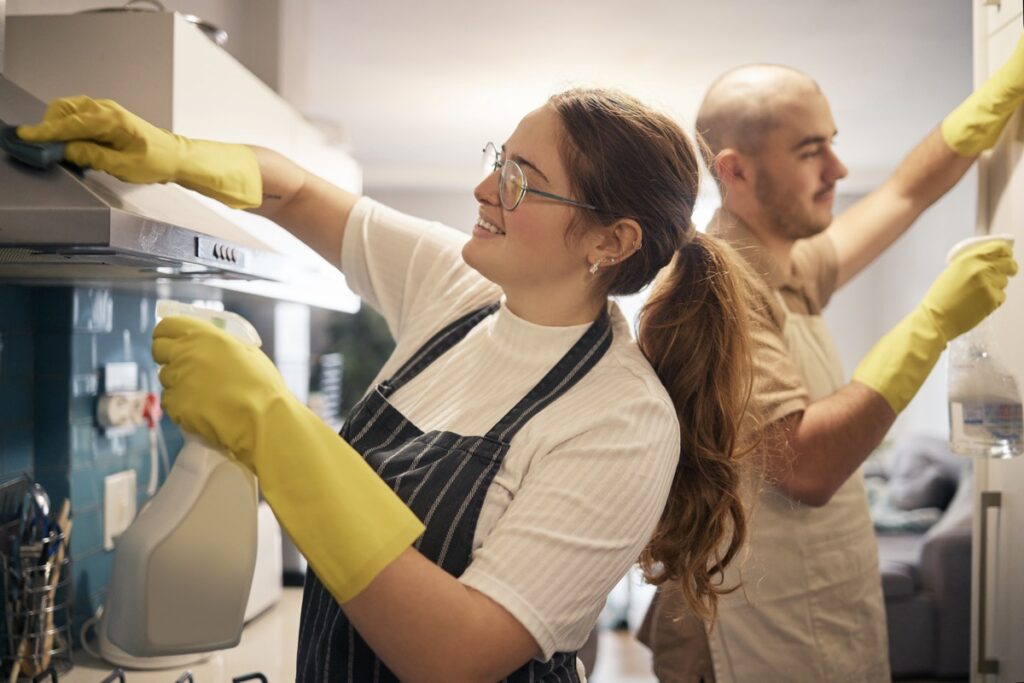 Most people try to clean everything every week. Sounds responsible. But it burns you out fast, and the results don’t match the effort. A smarter approach is to build your weekly routine around the zones that actually drive most of the mess — and let the lower-impact areas wait their turn.
Here’s how that looks in practice.
Start by splitting your home into two lists. List one holds your high-traffic zones: the kitchen, the main bathroom, the living room floor, and any entryway. These areas see the most daily use. Dirt, grease, and bacteria build up here fast. According to the National Sanitation Foundation, kitchen sinks and countertops consistently rank among the most germ-laden surfaces in any home. These spots need weekly attention, minimum.
List two holds everything else. Guest rooms. Formal dining areas. Hallway baseboards. The top shelf of the linen closet. These areas accumulate dust slowly and don’t affect day-to-day health or comfort the way your kitchen does. Clean them monthly, or even every six weeks. You won’t notice a difference — and that’s the point.
What a Real 80/20 Weekly Schedule Looks Like
We see this constantly with clients in the Orlando area: they spend 45 minutes cleaning a guest bathroom nobody used all week, then rush through the kitchen in 10 minutes. The whole house feels half-done. Flipping that ratio changes everything.
A practical 80/20 weekly routine might look like this:
- Monday: Kitchen surfaces, stovetop, and sink. These three spots alone cover a huge portion of bacterial load in any home.
- Wednesday: Main bathroom — toilet, sink, and tub or shower. Spot-mop the floor if needed.
- Friday: Living room and entryway. Vacuum high-traffic floor areas. Wipe down light switches and door handles.
- Weekend (as needed): A quick pass through any area that genuinely needs it. Not a full clean — just a response to actual visible mess.
That’s it. Secondary rooms rotate in on a monthly basis. Baseboards, ceiling fans, window sills — those go on a separate seasonal list entirely.
One thing most guides get wrong here: they tell you to clean every surface in a room when you enter it. That’s not 80/20 thinking. That’s just cleaning with extra steps. The real discipline is leaving things alone when they don’t need attention. A guest bedroom with the door closed all week does not need to be vacuumed on Friday. Walk past it.
In Florida’s climate, there’s one honest exception worth calling out. Humidity in the Orlando area — especially from late spring through early fall — means bathrooms and kitchens can develop mildew faster than in drier parts of the country. That doesn’t mean you clean more rooms. It means you pay closer attention to ventilation and moisture in those same high-impact zones you’re already targeting. Same 20% of areas. Just a little more focus there during humid months.
From a field perspective — having helped clients across the Orlando area develop routines that actually hold up over time — the clients who stick with this approach longest are the ones who write it down. Not a complicated chart — just a sticky note on the fridge with three rooms and three days. When the list is short, you actually do it. When the list is long, you avoid starting.
One client we worked with near the Suite G-100 Orlando area had been spending nearly three hours every Saturday trying to clean her whole apartment. After mapping her actual high-use zones, she cut that to about 75 minutes spread across three days — and told us the place felt cleaner because she was hitting the right spots consistently instead of exhausting herself on everything at once.
Consistency on the right 20% beats occasional effort on 100% every single time.
Now that you know which tasks actually matter, let us handle them for you. Our team brings this same 80/20 approach to every home we service in the Suite G-100 Orlando area — focusing where it counts so your space stays consistently clean without the guesswork. Learn more about our or call us at (407) 773-9787 to schedule your first visit. You’ve done the homework — we’ll do the rest.